Skip to content

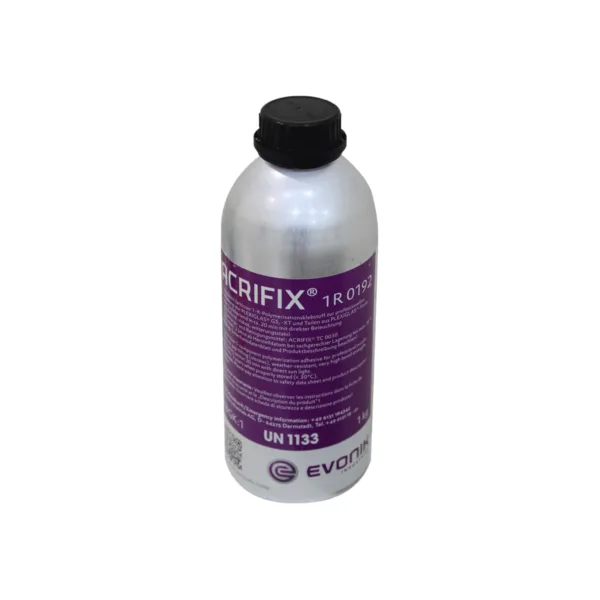
ACRIFIX® 1R 0192

ACRIFIX® 1R 0192

Price on request

One-component adhesive (MMA-based); cures under sunlight or ultraviolet radiation (fluorescent lamps, UV lamps, sunlight). Liquid. Fills gaps between clear extruded or cast acrylic, SAN, polystyrene or polycarbonate parts. Costura…

One-component adhesive (MMA-based); cures under sunlight or ultraviolet radiation (fluorescent lamps, UV lamps, sunlight). Liquid. Fills gaps between clear extruded or cast acrylic, SAN, polystyrene or polycarbonate parts. Clear, clean joint. Annealing bonded joints is recommended to prevent crazing.

Characteristics:

Purpose: wide joints, surface bonding of acrylic.

– Used in furniture, advertising displays, retail fixtures, engineering parts and aquariums.

– Crack filling

– Joint appearance: clear, bubble-free.

– Outdoor weather resistance.

– Bond strength: high.

Notes:

cures under UV radiation or normal daylight.

— Initial adhesion: 10–20 minutes under a UV lamp or 3 hours in normal daylight. — Full curing time: 3 hours after bonding.

— Viscosity: 1600–2000 mPA•s.

Irritates the skin and is flammable.

Product properties

  • Product code: YII-18

You may like

Leave a review

Your details

Rating *

Photo optional — JPG, PNG or WebP, max 2 MB.

Your review

Share your experience with this product.

What thickness should I choose?

The right thickness depends on the size, purpose, and load of the piece. Thin sheets are suitable for signs, covers, displays, and decorative parts. Thicker sheets are better for shelves, protective panels, furniture elements, and stronger constructions.

Can this material be used outdoors?

Some materials are suitable for outdoor use, especially when UV resistance and weather durability are required. Tell us where the material will be used, and we will help you choose the right option.

Can the product be cut to my size before delivery?

Yes. Most sheet materials can be cut to your required size before delivery. You can send exact measurements or upload a sketch for a custom quote.

What is the difference between acrylic and polycarbonate?

Acrylic is often chosen for clarity, clean appearance, displays, signs, and decorative elements. Polycarbonate is more impact-resistant and is usually preferred when strength and durability are important.

Can you make holes, rounded corners, or special shapes?

Yes. Depending on the material and thickness, we can cut holes, curves, rounded corners, circles, and complex shapes. For best results, send a drawing with measurements.

Are the edges finished after cutting?

Edges can be left standard or additionally polished, depending on the project. Polished edges give the piece a cleaner and more finished look, especially for visible products.